⏱️ 8 min read
In the previous chapter, The bottleneck isn't the code, it's the tests, the factory's first full night hid a strange number: 1h20 of testing was an agent waiting for a command to finish. With testing solved, a bigger question was left. Why was an AI waiting in the first place?
The answer was in a run from days before, the most expensive of the whole project. It delivered nothing.
This chapter is about that run, about the rule I took from it that same night and about a way of waiting I didn't know existed.
4:37 pm: the first task the factory picked up on its own
It was the Tuesday from chapter 2, The day AI took the wheel from me. At 3:46 pm, I had opened a session just to write down the backlog. At 4:37 pm, the tool took the first task from it and started working on it on its own: a screen to follow, live, what each run was doing.
Before going on, the legend for the rest of the chapter, the same one from chapter 4:
- ⚙️ Engine: the factory's orchestrator, which I introduced in chapter 1. A regular program, deterministic, with no AI, that always does the same thing the same way.
- 🤖 Agent: an AI doing the work.
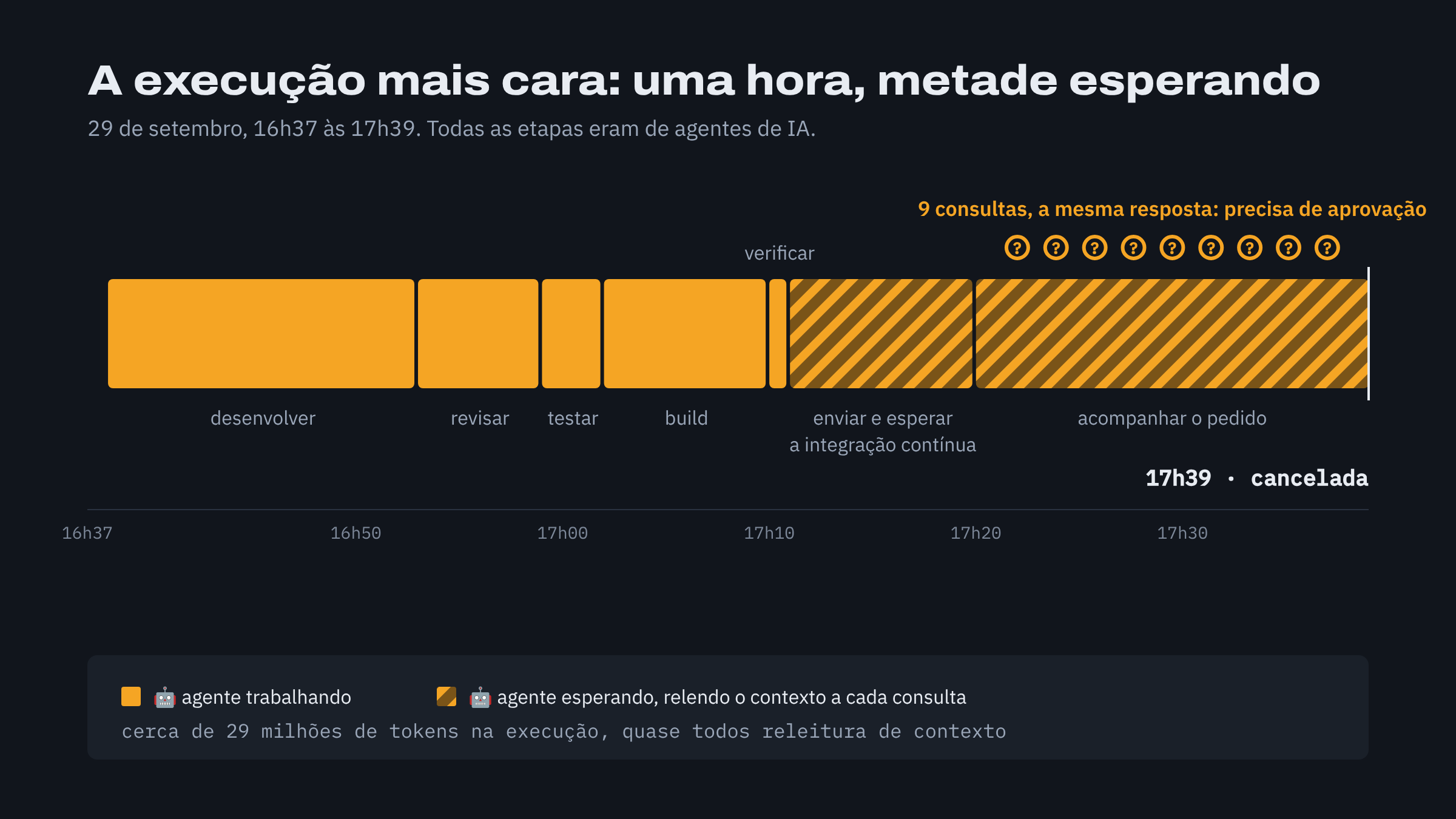
The start was the usual. The agent developed for about 20 minutes, another one reviewed, a third one wrote the tests. The build got stuck a few times, because a forgotten copy of the app was holding a file open, but it passed. The check passed. At 5:11 pm, the task reached the last two stages, the ones that take care of the code after it leaves the factory:
- 🤖 Send: an agent sends the code to GitHub, opens the request to merge it into main and waits for continuous integration.
- 🤖 Follow: another agent keeps an eye on that request until it is merged, answering whatever comes up along the way.
That's where the run stopped moving and kept spending.
The same question nine times
The agent following the request needed a GitHub command-line tool to read its state. That tool was off the list of what it could run without my permission.
So it asked. The answer was the same: it needs approval. It waited and asked again, and again. At some point, it wrote down on its own that it had already asked for access once, that the request had been ignored and that it would not ask again. And it kept checking.
There were nine checks, all with the same answer. The workflow told it to check the request every minute, for up to 12 hours. If I hadn't cancelled it, that would have been 12 hours of an AI asking whether a locked door had opened by itself.
The agent before it, the one sending the code, had already gone through something similar. It burned about 15 refused attempts until it found the way of calling the same tool that the list allowed. And the one waiting for continuous integration was also that agent, checking, turn after turn.
At 5:39 pm I cancelled it. In the log, the run has a single outcome: cancelled.
The cost of waiting
When I went to look at what it cost, the numbers told the same story as chapter 4, only louder:
- About 1 hour of run, from 4:37 pm to 5:39 pm.
- About 29 million tokens, and almost all of them were rereading the context.
- 9 checks on the same request, with the same answer.
- About 15 refused attempts until it found the allowed way of calling the tool.
- About 900 thousand tokens spent just waiting for continuous integration.
The rereading is the detail that matters. In chapter 4, I said the model rereads the whole context on every turn. A check that only asks "is it done yet?" looks cheap. For an AI, each of those questions is a read of the whole task, with everything it has done up to that point. The longer the task, the more expensive the same question gets.
A person waiting for a build finishes waiting and that's it. An AI waiting pays to remember what it was doing, every time it looks at the clock.
The rule, that same night
The cancellation was at 5:39 pm. The fixes came the same day, from the factory itself.
At 6:04 pm, the first one. A wait that gets the same "blocked" answer three times in a row stops waiting and raises a flag. The maximum follow-up time dropped from 12 to 4 hours, and the check went to every 2 minutes. And when an agent has several refused calls in a row, that shows up as an alert, instead of turning into expensive silence.
At 8:17 pm, the second one, which is the one that changed the design. The one waiting for continuous integration was no longer the AI. The engine started checking GitHub on its own, on its own clock, and calling the agent only when there is a result. The agent that sends the code also moved to a cheaper model, because what was left for it to do asked for less.
In the first run after that, at 8:33 pm, the engine checked continuous integration four times. The agent was called once.
The rule ended up like this:
- ⚙️ Waiting: the engine checks the status, the build, continuous integration, on its own clock and with no AI.
- ⚙️ Giving up: the same answer three times in a row ends the wait and calls someone.
- 🤖 Deciding: the agent only steps in when something arrives that calls for judgment. The test failed, the code conflicted, the review found a problem.
It's the same split chapter 4 made with testing: the engine runs, the agent judges. The difference is that, here, I only noticed after paying the highest bill of the project.
"Cancel the monitor"
That same week, on the night I told in chapter 3, I went to sleep and woke up to the work done, my last message before going to sleep was this:
"Cancel the monitor, I'm going to sleep and leaving the PC running."
The monitor was Claude following the runs for me. Every so often, it looked at whether something had finished or broken. It was exactly the agent of the nine checks, only on my side of the desk. I cancelled it because it made no sense to pay an AI to watch another AI work while I slept.
But I still wanted someone watching. And that's when I found out the problem already had a ready-made solution, inside Claude Code itself.
The Monitor that doesn't spend tokens
Claude Code has a feature called Monitor, which I didn't know about. The name is the same as the one I had cancelled, but the way it watches is the opposite. When I asked it to follow the runs, Claude itself explained to me how it works:
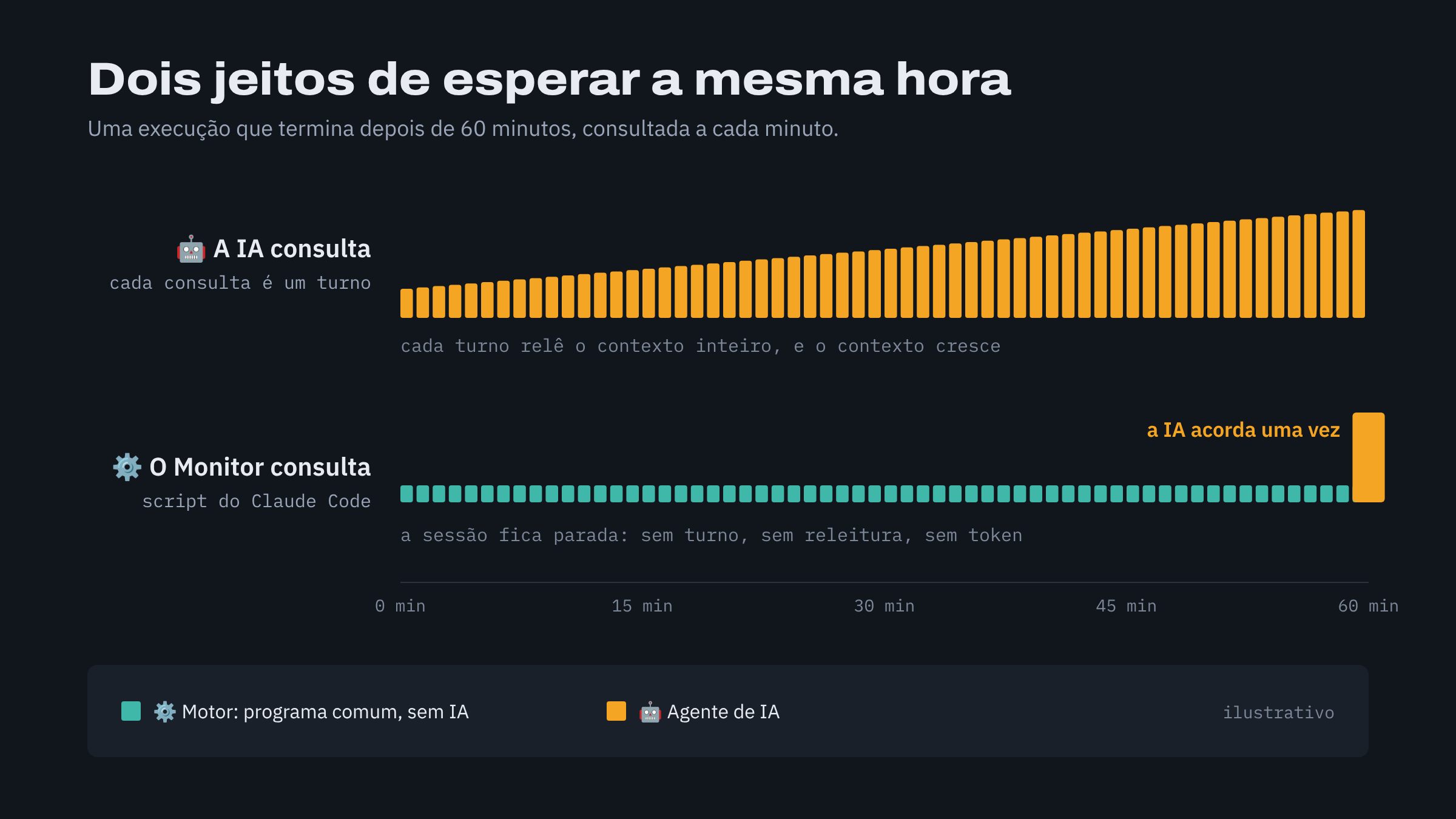
- ⚙️ The script watches: instead of watching by itself, Claude writes a small script that keeps running and checking the address that matters, every so often.
- ⚙️ The session sleeps: while the script runs, Claude's session stays idle. No turn, no rereading, no tokens.
- 🤖 The AI wakes up: when the script sees a result different from what it expected, a run that finished, one that failed, one that got stuck, it wakes Claude up. Only then does the AI step in, with something to decide.
It's the 8:17 pm rule, only outside the factory. The one keeping an eye on things is code, with no AI.
I started using this mode a lot at night, to follow the project's runs. I left the Monitor running, went to sleep, and Claude only woke up when there was something to look at.
What I take from this
The AI doesn't know it is spending while it waits. For it, checking one more time is just one more reasonable step. The one who has to know is the design of the workflow.
Today, when I build a new stage, I ask one question before any other: is there any waiting in here? If there is, it goes to the engine. The AI keeps the before and the after of the wait, never the wait itself.
And the rule that doesn't change still stands. The engine waits, gives up and calls, but it doesn't approve anything in my place. The blocked request that afternoon was waiting for a permission from me, and the right thing was to keep waiting for me. The wrong thing was paying an AI to keep asking.
The next step
Waiting was only half the problem that Tuesday. Later that same day, five runs ran in parallel, and four of them failed when merging code. There was no contradiction at all between them. They had only added a line at the end of the same file.
In the next chapter, chapter 6, Git was made for humans, I tell the story of that night and why, with several AIs working at the same time, even the format of a file becomes an architecture decision.